Difference between revisions of "10 Rules of Honeybee Management"
(Created page with "<br>Think back to your time in school. It wasn’t too hard to figure who were the "A students" and who were the "C students," right? The A [https://www.Youtube.com/watch?v=-l...") |
(Created page with "Bee management practices are strongly related to regional and environmental influences and therefore the suggestions on this page do not act as universal receipts on how to ma...") |
||
| Line 1: | Line 1: | ||
| − | + | Bee management practices are strongly related to regional and environmental influences and therefore the suggestions on this page do not act as universal receipts on how to manage honeybee colonies. Instead, by following these "rules", an increase of the quality of honeybee products (e.g. honey) and improvement of the health of honeybee colonies are possible. <br /> | |
| + | |||
| + | Within the EU Horizon 2020 project '''SAMS''' (Smart Apiculture Management Services) the following suggestions for improved beekeeping were elaborated with the help of bee and user centered design experts:<br /> | ||
| + | |||
| + | <big> | ||
| + | == '''<span style="color:#F2DACE">Rule 1: Secure quality of your product</span>''' == | ||
| + | <br /></big> | ||
| + | |||
| + | Honey needs some time after collection to ripe. Main reason is the water content. Honeybees cover ripe honey with beeswax and therefore capped cells are an indicator for ripe honey. Honey with too much water is still very similar to nectar and low in quality. There is a danger of fast fermentation which results in sour tasting honey. This risk is even higher in countries with high humidity. For honey wine, this fermentation is wanted but not for honey suitable for food consumption. Therefore, harvest honey only from frames that are at least 70% or even better 100% sealed. If you observe fermented honey, or moldy pollen, remove those frames from the hives. | ||
| + | |||
| + | <gallery widths=100px heights=300px mode="packed-hover"> | ||
| + | Honeycomb.png|Fully ripe honey comb recognizable by the capped cells. | ||
| + | </gallery> | ||
| + | |||
| + | <big> | ||
| + | == '''<span style="color:#F2DACE">Rule 2: Be sure the colony is breeding</span>''' == | ||
| + | <br /></big> | ||
| + | |||
| + | Reproduction indicates that your colony is strong and healthy. To check, if reproduction takes place, open the hive and look at the brood area. Do you see the queen, or all three stages of brood (i.e. eggs, bee larvae and capped brood)? If yes, chances are high that the colony is queenright (queen is present) and therefore develops normally. | ||
| + | |||
| + | <gallery widths=100px heights=300px mode="packed-hover"> | ||
| + | AceranaQueenright.png|''Apis cerana'' bees with capped and open brood, nectar, pollen and queen cells. | ||
| + | AMelliferaQueenright.png|''Apis mellifera'' bees with capped and open brood. | ||
| + | </gallery> | ||
| + | |||
| + | <big> | ||
| + | == '''<span style="color:#F2DACE">Rule 3: Be sure that your colony has enough food</span>''' == | ||
| + | <br /></big> | ||
| + | |||
| + | To be sure that your honeybee colony has enough food, every beekeeper should be aware of the colony surroundings. What plants are in flower and when? Is there a phenology calendar for your region which may help you? It is important, that your bees have enough melliferous plants in their environment (should be checked, before the hive is set up at the particular location). If there is a lack of forage opportunities, think of growing your own melliferous plants but not every plant is a nectar AND pollen producer! | ||
| + | It is also important to check not only the surroundings, but also the colony itself. When observing the flight entrance, do you see returning pollen foragers? When opening the hive, do you see combs filled with honey? If not, consider to offer supplemental food (carbohydrates and/or protein) outside of the honey harvesting season, otherwise you will adulterate the honey (quality loss, fermentation, …). Make sure to place the supplemental food on an upturned hive cover instead of putting it on the ground to avoid robbery and predators. Another important point in times of harvest is to leave sufficient reserves of honey and pollen for dearth periods. | ||
| + | |||
| + | <gallery widths=100px heights=300px mode="packed-hover"> | ||
| + | CalliandraSpp.png|One important nectar source in Indonesia is the plant ''Calliandra'' (Fabaceae). | ||
| + | Bee-Calendar-of-Plants.jpg| Example for a flower calendar (based on an area in Ireland). | ||
| + | </gallery> | ||
| + | |||
| + | <big> | ||
| + | == '''<span style="color:#F2DACE">Rule 4: Keep your colony healthy – aim for a low predator-, pest-, and pathogen- pressure</span>''' == | ||
| + | <br /></big> | ||
| + | |||
| + | There are numerous amounts of organisms affecting the honey bee ([[Bee pathology]]). As the organisms and the control methods strongly vary between regions, it is important to get in contact with experienced local beekeepers and (if existing) beekeeping associations that may provide that information for you. Maybe there are even authoritative services when you need help? It is not possible to free your colonies of every bee-health affecting organism, but it is very important to keep the pest/pathogen/parasite/predator-pressure as low as possible. Be aware, that the use of certain substances as antibiotics as a preventive measure is not allowed in every country. If the use of antibiotics or other chemical substances are necessary, you have to follow the instructions exactly. | ||
| + | |||
| + | <big> | ||
| + | == '''<span style="color:#F2DACE">Rule 5: Provide a safe environment for your beehives</span>''' == | ||
| + | <br /></big> | ||
| + | |||
| + | Choose a location, which is suitable and safe for your bees’ needs. The preferred area/location protects the hives from excessive weather conditions, has a low exposure to agricultural pesticides, and is rich in foraging opportunities throughout the season (nectar, pollen and water). | ||
| + | |||
| + | <big> | ||
| + | |||
| + | == '''<span style="color:#F2DACE">Rule 6: Provide a safe environment for yourself</span>''' == | ||
| + | <br /></big> | ||
| + | |||
| + | To provide a safe environment for yourself, do not open your colonies on days of unfavored weather conditions, overthink your steps prior to conduct them, work slowly and be calm and use equipment in a good condition. Work slowly and act calm when handling your colonies is important to avoid injuries and unnecessary working steps. Be sure to have the opportunity to call someone for advice or in case of injuries/emergencies. | ||
| + | |||
| + | <big> | ||
| + | == '''<span style="color:#F2DACE">Rule 7: Dark beeswax needs to be exchanged but wax is valuable - reuse it</span>''' == | ||
| + | <br /></big> | ||
| + | |||
| + | Replace frames containing dark wax and brood frames at least every second year to keep your colonies strong and healthy. As wax belongs to the most valuable raw materials for a beekeeper, be sure to recycle it by melting it down and reusing it. For this purpose, special wax smelters exist, but it is also possible to use solar power by putting the old wax in a bucket and leave it in the sun for several hours. To get to the valuable purified wax, simply skim off the waste. If you are not sure how to do it, youtube is a great tutorial tool. | ||
| + | |||
| + | <big> | ||
| + | == '''<span style="color:#F2DACE">Rule 8: Control UNWANTED swarming</span>''' == | ||
| + | <br /></big> | ||
| + | |||
| + | Swarming and absconding are two different things. While swarming occurs in terms of reproduction purposes, absconding happens in tropical areas, when the environmental factors are not suitable (anymore). In general, it is a good thing if bee colonies are strong enough to conduct reproductive swarming but if you do not want half of your bees leaving the hives, you may be interested in controlling reproductive swarming. For this purpose, you should requeen a colony every 2 years and offer enough room for your colonies. To avoid absconding, good beekeeping management is very important: keep the disease pressure low (rule 4), offer enough natural food and water and offer supplemental food in times of need (rule 3), manipulate the hives with methods that cause as less stress as possible (e.g. open and manipulate only in times of need). | ||
| + | |||
| + | <big> | ||
| + | == '''<span style="color:#F2DACE">Rule 9: Avoid robbery through other honeybees or other organisms</span>''' == | ||
| + | <br /></big> | ||
| + | |||
| + | Robbery through other honeybees or organisms like wasps, hornets, ants, or even mammals cause significant stress to your colonies. Strong bees defend their nesting sites more successfully, therefore it is very important to keep your colonies as strong as possible to avoid robbery. For this purpose, keep the disease pressure low (rule 4), place supplemental food on an upturned hive cover (rule 3), narrow down the size of the hive entrance, work in a hygienic way and do not leave your equipment or brood/honey containing frames accessible to bees and other organisms. | ||
| + | |||
| + | <big> | ||
| + | == '''<span style="color:#F2DACE">Rule 10: Educate yourself</span>''' == | ||
| + | <br /></big> | ||
| + | |||
| + | There are no rigid beekeeping rules that fit perfectly for every beekeeper and there is also no perfect system fitting all honey bees of the world. For this reason, it is essential to constantly educate yourself and to find out what’s happening in your region. Get in contact with other beekeepers and learn from each other. Find out if there is a local beekeeper network and if not, you may be interested in developing one by yourself. Are there possibilities to visit beekeeping trainings? Also visit the internet and watch for example YouTube videos on beekeeping but be critical and use only methods that fit to your region and bee race. It is also very helpful to document your hive management and phenology of forage by taking notes and compare them between years. | ||
Revision as of 17:11, 4 September 2019
Bee management practices are strongly related to regional and environmental influences and therefore the suggestions on this page do not act as universal receipts on how to manage honeybee colonies. Instead, by following these "rules", an increase of the quality of honeybee products (e.g. honey) and improvement of the health of honeybee colonies are possible.
Within the EU Horizon 2020 project SAMS (Smart Apiculture Management Services) the following suggestions for improved beekeeping were elaborated with the help of bee and user centered design experts:
Contents
- 1 Rule 1: Secure quality of your product
- 2 Rule 2: Be sure the colony is breeding
- 3 Rule 3: Be sure that your colony has enough food
- 4 Rule 4: Keep your colony healthy – aim for a low predator-, pest-, and pathogen- pressure
- 5 Rule 5: Provide a safe environment for your beehives
- 6 Rule 6: Provide a safe environment for yourself
- 7 Rule 7: Dark beeswax needs to be exchanged but wax is valuable - reuse it
- 8 Rule 8: Control UNWANTED swarming
- 9 Rule 9: Avoid robbery through other honeybees or other organisms
- 10 Rule 10: Educate yourself
Rule 1: Secure quality of your product
Honey needs some time after collection to ripe. Main reason is the water content. Honeybees cover ripe honey with beeswax and therefore capped cells are an indicator for ripe honey. Honey with too much water is still very similar to nectar and low in quality. There is a danger of fast fermentation which results in sour tasting honey. This risk is even higher in countries with high humidity. For honey wine, this fermentation is wanted but not for honey suitable for food consumption. Therefore, harvest honey only from frames that are at least 70% or even better 100% sealed. If you observe fermented honey, or moldy pollen, remove those frames from the hives.

Fully ripe honey comb recognizable by the capped cells.

Rule 2: Be sure the colony is breeding
Reproduction indicates that your colony is strong and healthy. To check, if reproduction takes place, open the hive and look at the brood area. Do you see the queen, or all three stages of brood (i.e. eggs, bee larvae and capped brood)? If yes, chances are high that the colony is queenright (queen is present) and therefore develops normally.

Apis cerana bees with capped and open brood, nectar, pollen and queen cells.

Apis mellifera bees with capped and open brood.


Rule 3: Be sure that your colony has enough food
To be sure that your honeybee colony has enough food, every beekeeper should be aware of the colony surroundings. What plants are in flower and when? Is there a phenology calendar for your region which may help you? It is important, that your bees have enough melliferous plants in their environment (should be checked, before the hive is set up at the particular location). If there is a lack of forage opportunities, think of growing your own melliferous plants but not every plant is a nectar AND pollen producer! It is also important to check not only the surroundings, but also the colony itself. When observing the flight entrance, do you see returning pollen foragers? When opening the hive, do you see combs filled with honey? If not, consider to offer supplemental food (carbohydrates and/or protein) outside of the honey harvesting season, otherwise you will adulterate the honey (quality loss, fermentation, …). Make sure to place the supplemental food on an upturned hive cover instead of putting it on the ground to avoid robbery and predators. Another important point in times of harvest is to leave sufficient reserves of honey and pollen for dearth periods.

One important nectar source in Indonesia is the plant Calliandra (Fabaceae).
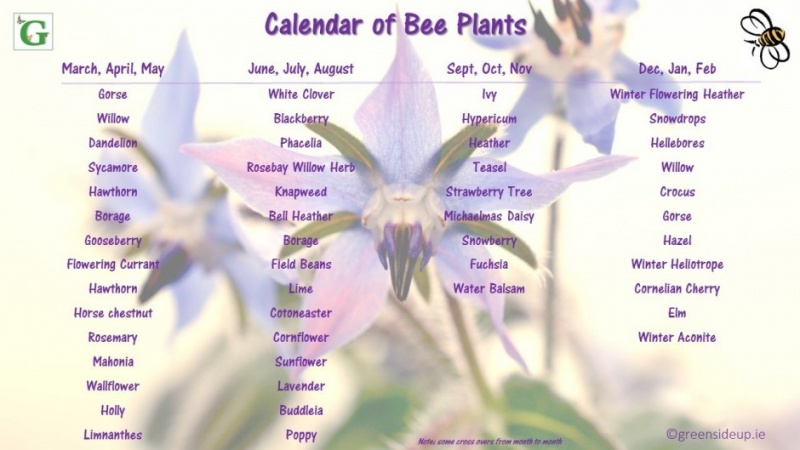
Example for a flower calendar (based on an area in Ireland).


Rule 4: Keep your colony healthy – aim for a low predator-, pest-, and pathogen- pressure
There are numerous amounts of organisms affecting the honey bee (Bee pathology). As the organisms and the control methods strongly vary between regions, it is important to get in contact with experienced local beekeepers and (if existing) beekeeping associations that may provide that information for you. Maybe there are even authoritative services when you need help? It is not possible to free your colonies of every bee-health affecting organism, but it is very important to keep the pest/pathogen/parasite/predator-pressure as low as possible. Be aware, that the use of certain substances as antibiotics as a preventive measure is not allowed in every country. If the use of antibiotics or other chemical substances are necessary, you have to follow the instructions exactly.
Rule 5: Provide a safe environment for your beehives
Choose a location, which is suitable and safe for your bees’ needs. The preferred area/location protects the hives from excessive weather conditions, has a low exposure to agricultural pesticides, and is rich in foraging opportunities throughout the season (nectar, pollen and water).
Rule 6: Provide a safe environment for yourself
To provide a safe environment for yourself, do not open your colonies on days of unfavored weather conditions, overthink your steps prior to conduct them, work slowly and be calm and use equipment in a good condition. Work slowly and act calm when handling your colonies is important to avoid injuries and unnecessary working steps. Be sure to have the opportunity to call someone for advice or in case of injuries/emergencies.
Rule 7: Dark beeswax needs to be exchanged but wax is valuable - reuse it
Replace frames containing dark wax and brood frames at least every second year to keep your colonies strong and healthy. As wax belongs to the most valuable raw materials for a beekeeper, be sure to recycle it by melting it down and reusing it. For this purpose, special wax smelters exist, but it is also possible to use solar power by putting the old wax in a bucket and leave it in the sun for several hours. To get to the valuable purified wax, simply skim off the waste. If you are not sure how to do it, youtube is a great tutorial tool.
Rule 8: Control UNWANTED swarming
Swarming and absconding are two different things. While swarming occurs in terms of reproduction purposes, absconding happens in tropical areas, when the environmental factors are not suitable (anymore). In general, it is a good thing if bee colonies are strong enough to conduct reproductive swarming but if you do not want half of your bees leaving the hives, you may be interested in controlling reproductive swarming. For this purpose, you should requeen a colony every 2 years and offer enough room for your colonies. To avoid absconding, good beekeeping management is very important: keep the disease pressure low (rule 4), offer enough natural food and water and offer supplemental food in times of need (rule 3), manipulate the hives with methods that cause as less stress as possible (e.g. open and manipulate only in times of need).
Rule 9: Avoid robbery through other honeybees or other organisms
Robbery through other honeybees or organisms like wasps, hornets, ants, or even mammals cause significant stress to your colonies. Strong bees defend their nesting sites more successfully, therefore it is very important to keep your colonies as strong as possible to avoid robbery. For this purpose, keep the disease pressure low (rule 4), place supplemental food on an upturned hive cover (rule 3), narrow down the size of the hive entrance, work in a hygienic way and do not leave your equipment or brood/honey containing frames accessible to bees and other organisms.
Rule 10: Educate yourself
There are no rigid beekeeping rules that fit perfectly for every beekeeper and there is also no perfect system fitting all honey bees of the world. For this reason, it is essential to constantly educate yourself and to find out what’s happening in your region. Get in contact with other beekeepers and learn from each other. Find out if there is a local beekeeper network and if not, you may be interested in developing one by yourself. Are there possibilities to visit beekeeping trainings? Also visit the internet and watch for example YouTube videos on beekeeping but be critical and use only methods that fit to your region and bee race. It is also very helpful to document your hive management and phenology of forage by taking notes and compare them between years.
